
Indicators of emitter wear
Emitter wear can be described by the width, depth, and appearance of the electrode pit.
Emitter wear can indicate when to replace the electrode. The number of starts and the arc-on time can have an effect on emitter wear.
Emitter wear can cause the cut quality to degrade. Your cut quality requirements will indicate when to replace the electrode.
Note:
If an electrode needs replacement because of emitter wear, always replace the nozzle at the same time as the electrode. Use the electrode torque tool (429013) to correctly tighten the electrode.
The following guidelines for how to evaluate emitter wear apply to hafnium-emitter
electrodes:
- The face of a new electrode looks shiny and smooth.
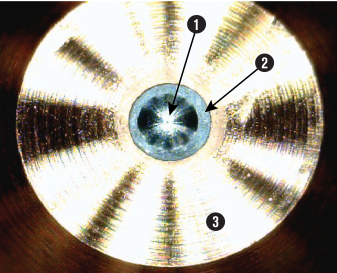
1 Electrode pit 2 Hafnium emitter 3 Electrode face - If the electrode pit diameter extends beyond the hafnium, as shown, replace the
electrode and nozzle.
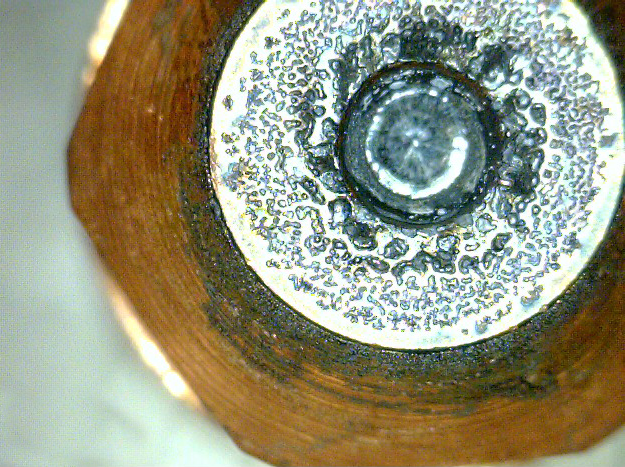
- If you see a non-symmetrical, rough-edged pit and rough-surfaced electrode face,
replace the electrode and nozzle. Always replace the nozzle at the same time as
the electrode.
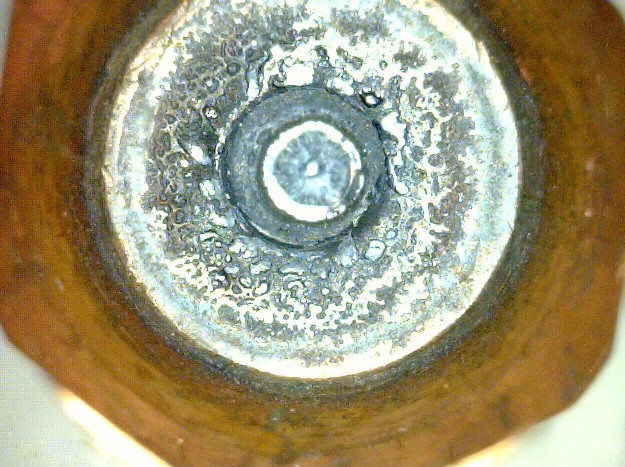
- In general, if the electrode pit depth exceeds the guidelines in the following table, replace the electrode and nozzle.
| Electrode amperage | Replacement pit depth 1 | Description |
|---|---|---|
| < 130 A | ≥ 1 mm (0.04 in) | In general, for electrodes less than 130 A, replace the electrode when the pit depth is 1 mm (0.04 in) or greater. |
| ≥ 130 A and < 220 A | ≥ 1.25 mm (0.05 in) | In general, for electrodes greater than or equal to 130 A and less than 220 A, replace the electrode when the pit depth is 1.25 mm (0.05 in) or greater. |
| ≥ 220 A | ≥ 1.5 mm (0.06 in) | In general, for electrodes greater than or equal to 220 A, replace the electrode when the pit depth is 1.5 mm (0.06 in) or greater. |
1 Based on your cut-quality
requirements, it can be necessary to replace your electrode at a pit
depth that is shallower or deeper than these
guidelines. | ||