
Examine the electrode for emitter wear
Emitter wear can indicate when to replace the electrode. Increasing the number of starts and the arc-on time can cause the emitter to wear more quickly. Emitter wear can cause the cut quality to decrease. Your cut-quality requirements will indicate when to replace the electrode.
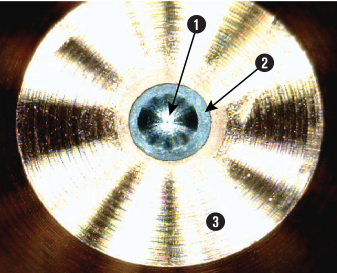
| 1 | Electrode pit |
|---|---|
| 2 | Hafnium emitter |
| 3 | Electrode face |
Note:
If an electrode needs replacement because of emitter wear, always replace the nozzle at the same time as the electrode. Use the electrode torque tool (429013) to correctly tighten the electrode.
-
Examine the electrode pit diameter
for
these
conditions:
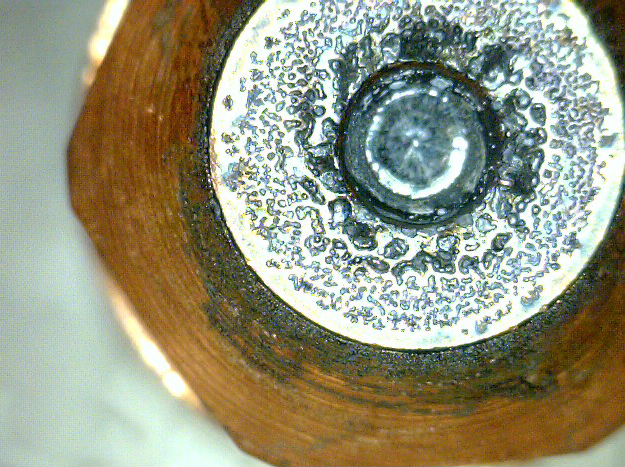
-
If the diameter
extends
beyond the hafnium,
replace the electrode and nozzle.
-
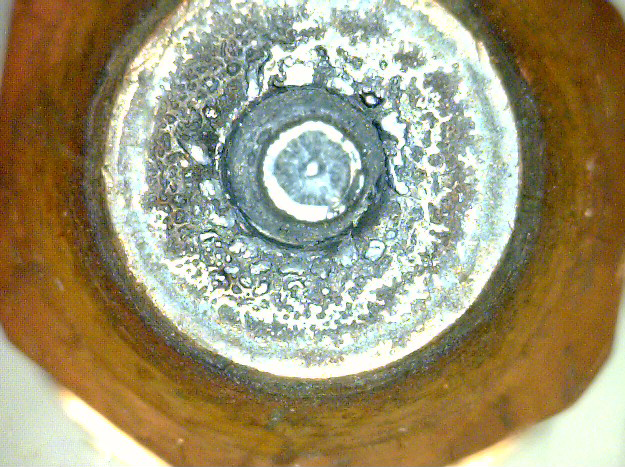
If you see a non-symmetrical, rough-edged pit and rough-surfaced
electrode face, replace the electrode and nozzle.
-
If the diameter
extends
beyond the hafnium,
replace the electrode and nozzle.
-
Use an electrode pit-depth gauge to measure the pit depth on the
electrode.
A pit-depth gauge is available from Hypertherm®.
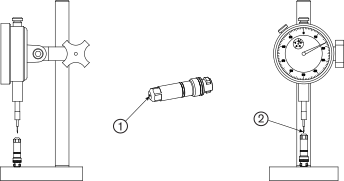
1 Electrode pit 2 Pit-depth gauge Note:The electrode shown is not to scale.