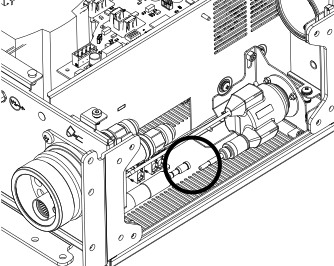
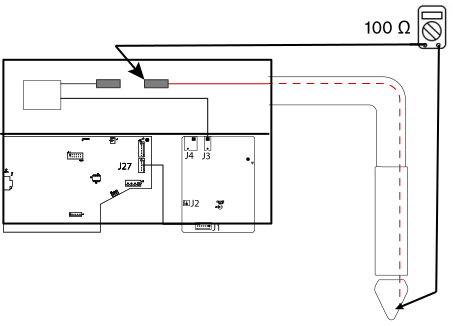
Use this test to examine the resistance from the torch tip to the ohmic relay in the
plasma cutting system. This test helps to find ohmic contact issues.
-
Remove the power from the cutting
system.
-
Remove the top panel and the side panels from the TorchConnect™ console.
-
Examine the J2 connector on the ohmic contact Printed Circuit Board (PCB).
Make sure that the ohmic-relay coil is connected. Reconnect or tighten the
ohmic-relay coil if necessary.
-
Disconnect the ohmic-relay connector to get access to the bullet connector on
the torch receptacle block-side inside of the TorchConnect console.
To disconnect the ohmic-relay connector, unscrew and unplug it.
-
Use a digital multimeter to measure the resistance from the torch tip to the
ohmic relay.
-
If the resistance is infinite (open), replace the torch lead.
-
If the resistance is less than 100 ohms (Ω), continue with the next
step.
-
Reconnect the ohmic-relay connector.
-
Examine the ohmic contact PCB.
-
If the PCB configuration is for
internal ohmic, make sure that the ohmic wire from the ohmic relay is
connected to J3.
-
If the PCB configuration is for
external ohmic, make sure that the ohmic wire from the ohmic relay is
connected to J4 pin 2 and that the ohmic wire from the lifter is
connected to J4 pin 1.
-
Adjust or tighten connections, if necessary, and continue with the next
step.
-
Supply power to the cutting
system.
-
Make sure that the torch does not touch the workpiece.
-
Use a digital multimeter to look for 24 VDC between the workpiece, or chassis
ground, and the torch tip (J3 or J4).
-
If there is no 24 VDC, examine the wiring to the ohmic PCB.
-
Make sure that the J3 or J4 connector is not clamped onto the wire
insulation.
-
Make sure that the connection between the J2 or J2A connector and the
relay coil is good.
-
Replace the relay if necessary.
-
If you find 24 VDC, continue with these steps:
-
Make sure that both the workpiece and the TorchConnect console are grounded in the same
location.
-
Touch the torch tip to the workpiece, or attach a jumper wire between
the torch tip and the chassis ground.
-
Examine the D2 Light Emitting Diode (LED) on the ohmic
contact PCB.
-
Examine the D15 LED on the
control PCB.
-
Make sure that D2 and D15 both illuminate.
-
If D2 and D15 both illuminate, make sure that the Computer Numerical Control (CNC) can receive ohmic contact signals from the
cutting system or Torch Height Control (THC).
If the CNC can receive ohmic
contact signals, refer to the instruction manual for your
CNC for troubleshooting
recommendations.
-
If D2 is not illuminated, replace the ohmic contact PCB.
-
If D2 (on the ohmic contact PCB)
is illuminated and D15 (on the control PCB) is not illuminated, examine the
PCB wiring harnesses for
loose
wiring.
-
If you cannot find
or correct the problem, speak to your cutting machine supplier or regional Hypertherm® Technical Service team.