
Troubleshooting for TSO and TSC faults
A flashing Torch Cap fault Light Emitting Diode (LED) identifies either a Torch Stuck Open (TSO) or a Torch Stuck Closed (TSC) condition.
- TSO
- The nozzle and electrode components inside the Hypertherm® cartridge are not touching after a Start signal is received.
- TSC
- The nozzle and electrode components inside the Hypertherm cartridge will not disconnect from each other after a Start signal is received.
Fault codes and fault LEDs
| Fault code | Fault LEDs | Torch LED | Description | Stops the system from operating? |
|---|---|---|---|---|
| None |

Flashes slowly |

Yellow |
There is a TSO condition. | Yes. These faults stop the torch from firing a plasma arc. In some conditions, you can fire the torch again and continue to cut. |
| None |
Flashes quickly |
There is a TSC condition. |
Corrective action for the Hypertherm cartridge
- If the Hypertherm cartridge became loose or was removed while the plasma power supply was ON and the torch-lock switch was set to the green "ready to fire" position, set the power switch on the plasma power supply to OFF (O), correct the problem, and set the power switch to ON (I) to remove the fault.
- Examine the Hypertherm cartridge to make sure that it is not worn and does not have damage.
-
Are you using a hand torch or a mechanized torch?
Option Description Hand torch - Move the torch-lock switch to the yellow lock position, then move the torch-lock switch to the green "ready to fire" position.
- Fire the torch one time to get the warning puffs of air. This can clean away unwanted material that has collected around the tip of the Hypertherm cartridge.
Mechanized torch Continue with the next step. - Remove the Hypertherm cartridge and carefully shake it to remove unwanted material that has collected inside the Hypertherm cartridge.
- Install a new Hypertherm cartridge.
Corrective action for TSO faults that occur during postflow
A Start signal during postflow causes the remaining air pressure in the torch lead to quickly decrease. If the pressure does not decrease quickly enough, the electrode will possibly not return to its closed position in time to form the pilot arc. A TSO fault occurs.
After each step, try to fire the torch again.
-
Do an inspection of the torch lead.
- If the torch lead is installed in a track, remove the torch lead from the track.
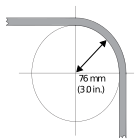
- Does the torch lead have any kinks or bends? Do not bend the torch lead around a radius that is less than the minimum bend radius of 76 mm (3.0 inches).
- Are there cable ties around the torch lead that are too tight?
- Are there any signs of a gas leak?
-
If possible, do a continuity check on the torch lead with a Hypertherm cartridge installed.
-
Make sure that a Hypertherm cartridge is
installed on the torch and that the torch is not connected to the plasma power
supply.
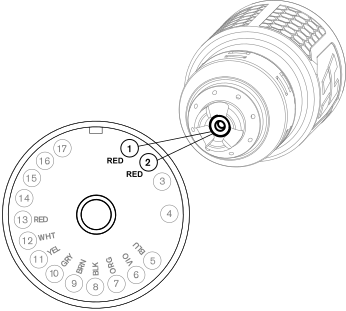
-
Make sure that a Hypertherm cartridge is
installed on the torch and that the torch is not connected to the plasma power
supply.
Corrective action for the torch
-
Do a check for continuity on the original torch:
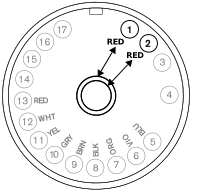
- Make sure that a Hypertherm cartridge is installed on the torch and that the torch is not connected to the plasma power supply.
- Do a check for continuity between pin 1 in the torch connector and the brass in the center of the connector.
- Do a check for continuity between pin 2 in the torch connector and the brass in the center of the connector.
Corrective action for the plasma power supply
-
Set
the power switch to OFF (O), and disconnect the power cord from the power
source.
Warning 

-
Measure the resistance between the red wire group and the white wire
from the torch receptacle.
These wires have the labels RED and WHT on the power Printed Circuit Board (PCB).
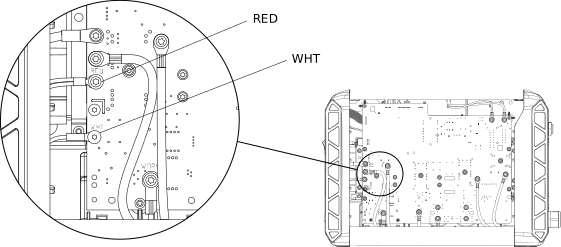
If you see this condition... Do these steps... The resistance is very low. Continue with the next step. The resistance is open. - Install a different Hypertherm cartridge.
- Examine the torch lead to find if one of the wires in the lead is broken. Replace the torch lead if necessary.
Verification
- Because TSO and TSC faults can be intermittent, do these troubleshooting steps as many times as necessary.